Build new tables
Build new tables
“We don’t need seats at the table. We need to build new tables.”
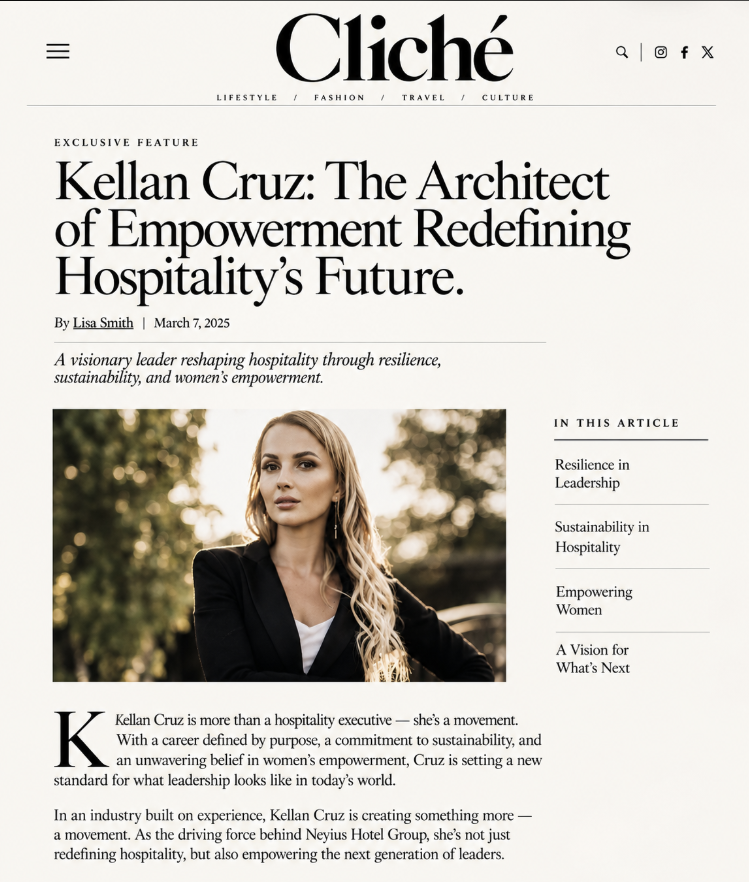
I said that to Cliché Magazine earlier this year, and the phrase has stayed with me. It is not just a soundbite; it is the operating principle of my career.
For years, the prevailing advice for women in leadership—especially in hospitality, an industry historically built on our invisible labor—was to lean in, speak up, and claim a seat at the existing table. But I realized something crucial along the way: a seat at a table built without you in mind is still a guest chair. You are there by permission, not by design. You are expected to adapt to the rules, the rhythm, and the culture of the people who built it.
Building a new table means setting the foundation yourself. It means creating spaces where empathy, sustainability, and humanity are not afterthoughts squeezed in between profit margins, but the very architecture of the business. It is about leading with the knowledge that my eight-year-old son, Eathan, is watching, and asking myself what kind of industry, and what kind of world, I am handing to him.
I did not get to where I am by waiting for an invitation. I got here by recognizing that if the room is not designed for your success, you do not just ask for a better chair. You build a new room.
Pairing people on purpose
Building a new table requires intentional design. You cannot simply declare that you value diverse voices and then wonder why the room sounds exactly the same as it always has. At Neyius Hotel Group, we decided to stop waiting for the traditional pipeline to fix itself and started building our own.
Last year, we launched a formal mentorship program that intentionally pairs our female executives with entry-level staff.
Why? Because talent is equally distributed, but opportunity is not.
What this program has taught me is profound. When you strip away the titles, the corner offices, and the corporate jargon, you find a wellspring of untapped brilliance. I have learned that the housekeeper in Phoenix or the front desk agent in Austin often has a clearer, more practical understanding of our operational flaws—and their solutions—than anyone in the corporate suite.
This initiative is not about charity, and it is certainly not about checking a diversity box. It is about recognizing a fundamental truth: the women who have historically done the heavy, unseen lifting in hospitality are the exact people who should be guiding its future. We are making that labor visible, valued, and vital to our strategy.
The results speak for themselves. Today, 60% of our General Manager roles are held by women. That number is not an accident, and it is not a coincidence. It is the direct result of pairing people with purpose, giving them real access to leadership, and providing the tools they need to rise. When you open a door, you have to make sure it stays open behind you.
Who gets heard
This brings me to a fundamental truth about leadership that I learned a long time ago: ideas are not distributed by rank.
Early in my career, when I was put in charge of our first branded hotel acquisition, I was young, and I knew exactly how much I did not know. I did not try to fake expertise I did not have. Instead, I did the only thing that made sense: I showed up prepared, I smiled, and I listened harder than anyone else in the room.
That habit has never left me. In fact, it is the cornerstone of how I lead today.
I run this company with a deliberately small, fiercely loyal core team. We avoid corporate bloat because I believe that small teams move mountains when they are truly empowered. But empowerment is meaningless if leadership is deaf.
I host monthly fireside chats with staff across our properties because I want to hear the unvarnished truth. I am wary of polish for its own sake. I would rather hear a voice crack with genuine concern than hear a perfectly rehearsed, smoothed-over corporate update. Authenticity is the only foundation that holds real weight. You cannot build a resilient team on a foundation of unspoken truths or hierarchical silence.
When you lead with empathy instead of ego, you create an environment where people feel safe enough to tell you when you are wrong. And that is where real innovation happens. It is not about the CEO having all the answers; it is about creating a culture where the best answer can come from anywhere, at any time.
Last remarks on the subject
Building a new table is hard work. It requires tearing up old blueprints, challenging entrenched norms, and refusing to accept the status quo simply because it is comfortable. There are days when the friction is exhausting.
But then I look at the teams we have built. I think about the colleague who was given their first real opportunity to lead and rose to the occasion. I think about the doors we are holding open for the next generation of women in this industry. And I think about the legacy of steady, principled effort I am modeling for my son.
I know, without a doubt, that it is the only work worth doing.
We are not asking for a seat anymore. We are building the room. And there is plenty of space at this table for anyone willing to do the work.